
A unified innovation and product development framework adopted across Telstra’s new Product Innovation & Strategy department. This resolved years of methodological fragmentation, establishing shared language across design, product, and engineering, and introducing ‘Lean Startup’ concepts of ‘innovation accounting’ and ‘portfolio bets’ to set realistic expectations for ROI across an enterprise innovation pipeline.
The problem
Telstra had consolidated product development and innovation teams from multiple business units into a single new department. Each team arrived with its own core methodology — design thinking, agile, lean startup, design sprints — and its own vocabulary for describing very similar work.
Product managers were confused by conflicting jargon. Agile and design thinking was perceived as being in conflict rather than complementary, and innovation thinking from specialist teams was at risk of being lost entirely in the consolidation.
The department’s mission was to accelerate adjacent revenue growth which required teams to be aligned in how they worked.

Approach
1. Consultation
- Interviews
- Workshops
2. A new framework
- Meta analysis
- Principles
3. Change
- Showcases
- Toolkit
Consultation
Interviews and workshops with design, product, and innovation leaders across six business units surfaced that the problem wasn’t with any particular methodology but the absence of a model that showed how they related to each other and when each one applied.
A new framework
The framework was built through meta-analysis of existing approaches, returning to original source material where necessary to untangle where interpretations had diverged. A revised Double Diamond was updated to integrate Design Sprints and make explicit the requirement to address commercial, customer, and technical questions together and not sequentially.
A visual of an ‘innovation pipeline’ introduced the concept of portfolio bets and initiative maturity, giving leadership a shared model for managing a range of initiatives at different stages simultaneously and setting honest expectations for when different kinds of ROI would materialise.
Change
The new consolidated model was tested and refined with stakeholders to create a toolkit of supporting materials. Workshops helped to define shared principles of customer centricity and innovation.The change programme included showcases, a shared toolkit, and communications framing the case for change in terms of real Telstra problems making it immediately relevant rather than theoretically correct.

The framework


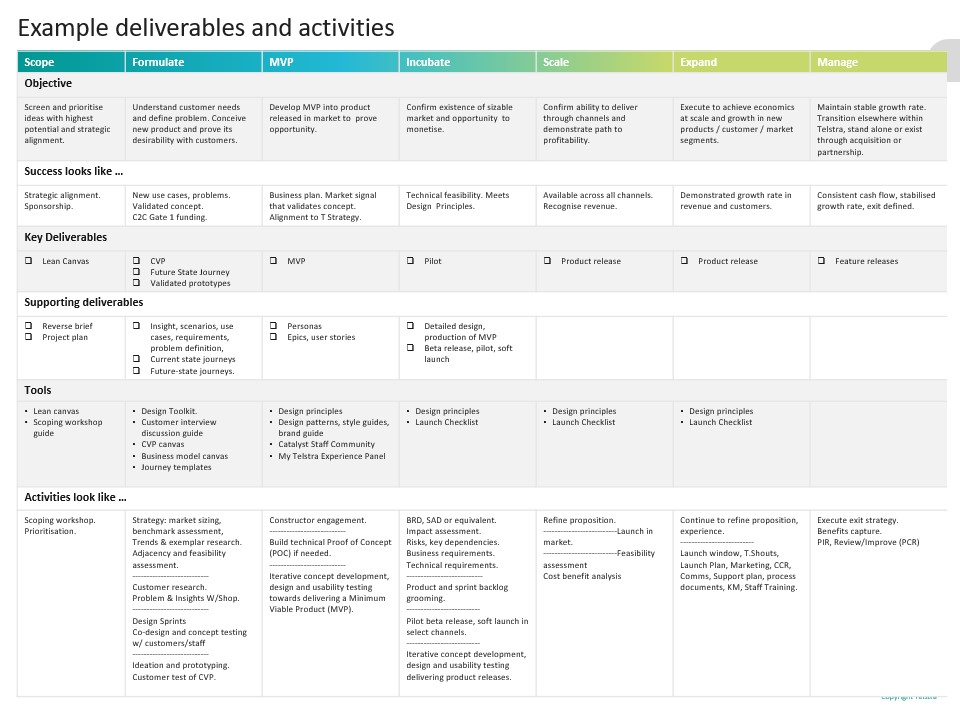

What this case demonstrates
Methodology fragmentation is a common barrier to effective product development in large organisations. The solution is rarely picking one methodology and mandating it. It’s building a model that shows how existing approaches relate to each other, when each one serves a purpose, and what good outcomes look like at every stage.
My Role
Initiative lead and primary author
Scope
Enterprise innovation framework
Contributors
From Product Innovation & Strategy:
Andreas Skold, Priya Paramanathan, Will Guiney
From Product Design:
Jane Curtain, Nifeli Stewart
From Global Products:
Megan Tyler, Sharon Dowsett,
Company
Telstra